Product content
I worked as a Senior Content Designer on internal enterprise tools at Meta, supporting teams across supply chain, procurement, and foundational systems used daily across the company.
Because this work was internal, I can’t share screens or detailed flows. What I can share is the type of problems I worked on, how I approached them, and the outcomes we were aiming for.
Note: Due to confidentiality, the images shown are illustrative mock-ups intended to convey concepts rather than production interfaces.
My role
I partnered with product, design, and engineering to improve clarity in complex operational workflows. Much of the work involved creating shared language, defining system states, and designing repeatable content patterns that could scale across surfaces.
The challenges
The tools I worked on supported complex operational workflows that spanned multiple teams and systems. They were often built incrementally over time, which made them powerful but difficult to reason about without deep context. The work required reducing risk and uncertainty for users, especially in moments where mistakes were costly or hard to undo.
How I approached the work
I treated content as part of the system, not a finishing layer.
Rather than optimising individual screens, I focused on shared language, clear system states, and repeatable patterns that could hold up as products changed and scaled.
This meant balancing long-term consistency with the practical need to ship, staying close to the work while designing for reuse.
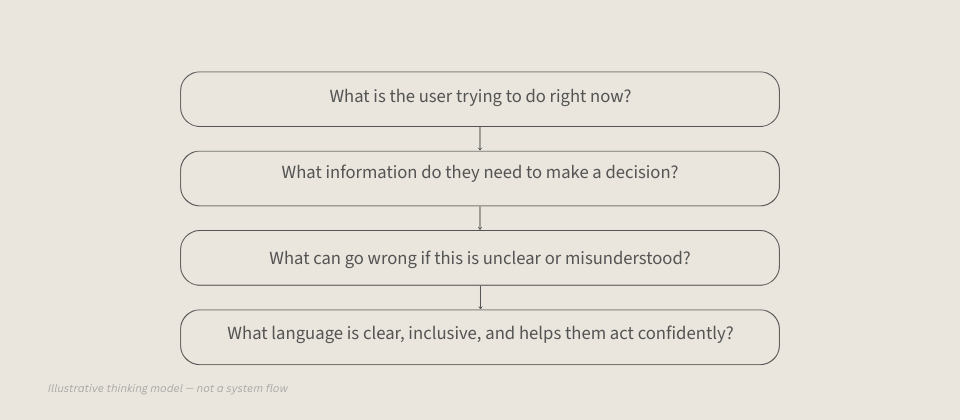
Example problems I worked on
Order management and monitoring
0-1 Supply chain tooling used by teams to manage orders, from individual components to completed hardware. Timelines were tight, so users needed clear visibility into status, errors, delays, and on-time delivery performance.
My role
I designed and clarified system states, table columns, and next-step guidance across key points in the workflow, partnering with product, design, and engineering to align language and behaviour.
Focus
Clear state naming and status language
Ownership cues to signal responsibility
Predictable next-step patterns within complex tables
Reducing ambiguity at high-risk decision points
Outcome
The improved clarity helped users act more quickly and resolve errors earlier in the process. This reduced follow-up questions and uncertainty in high-risk moments. Because delays could directly affect shipment timelines, the work reduced the risk of revenue loss from manufacturing issues.
Approvals
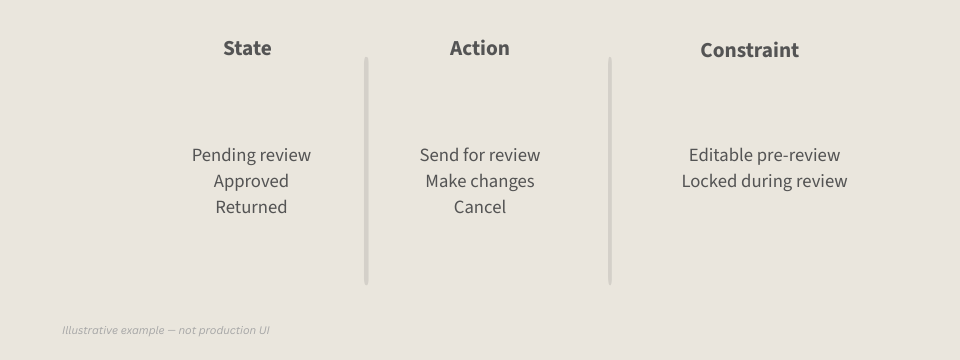
An internal approvals tool used by managers to review requests ranging from headcount and offsites to enterprise software spend. These decisions carried financial and operational implications, so clarity around status, constraints, and next steps was critical.
My role
I worked within an existing structure to clarify state language, action labels, and guidance at key points in the workflow. The work was often iterative and responsive, addressing ambiguity as issues surfaced.
Focus
Clear and consistent state naming
Defining actions in context of approval stage
Reducing ambiguity around ownership and next steps
Improving clarity in high-stakes decision moments
Outcome
The clearer state and action language helped reduce confusion during review and approval, especially in scenarios where delays or errors had financial implications.
Foundations
As products and internal systems scaled across Meta, inconsistencies in terminology, states, and interaction patterns created friction and rework. There was a need for shared standards to ensure clarity and consistency across teams and surfaces.
My role
I created and maintained content standards, contributed to a reusable string library, and reviewed and approved shared terminology used across teams. I partnered with product and design to align language at a broader organisational level.
Focus
Establishing shared terminology and definitions
Defining reusable patterns for common states and actions
Contributing to and maintaining a central string library
Supporting adoption of consistent language across teams
Outcome
The standards and shared terminology improved consistency at scale and reduced duplication across products. This enabled teams to move faster while maintaining clearer, more predictable user experiences.